Tech
Blog
The Feedback That Never Gets Said
Picture this: Maya is a senior product manager at a fast-growing tech company. She's smart, driven, and deeply committed to her work. She wants to be seen as a strategic thinker — someone who shapes product direction, not just executes on it.
Her manager sees something different.
Every time a critical bug surfaces, Maya drops everything. She's the first to jump into Slack, the first to coordinate the fix, the first to stay late. Her manager admires the dedication — but privately worries that this "drop everything to fix a fire" pattern is exactly what's getting in the way of Maya being perceived as strategic. The behavior Maya thinks demonstrates commitment is the same behavior that's quietly capping her career.
Here's the problem: nobody told her.
Not in her last performance review. Not in her 1:1s. Not in the annual engagement survey. The feedback existed — it was sitting in her manager's head, in her peers' observations, in her direct reports' daily experience of her. But it never made it to Maya in a form she could actually use.
This is the central failure of traditional feedback systems. And it's not a technology problem. It's a human one.
Why 360 Feedback Matters — and Why It Usually Fails
The research on 360-degree feedback is clear: when done well, it is one of the most powerful tools for professional development available to organizations.
Adam Grant, organizational psychologist and bestselling author of Think Again, has long argued that the most effective feedback creates genuine self-reflection — not defensiveness. His research shows that people grow fastest when they receive specific, behavioral feedback from multiple perspectives, not a single manager's view filtered through power dynamics.
Amy Edmondson of Harvard Business School, whose landmark work on psychological safety has shaped how we think about team performance, found that people share honest feedback only when they feel safe doing so. In most organizations, that safety doesn't exist — especially when feedback flows upward or across peer groups where political risk is real.
Kim Scott, author of Radical Candor, puts it plainly: most managers don't give honest feedback because they're afraid of hurting feelings or damaging relationships. The result is what she calls "ruinous empathy" — feedback so softened it becomes useless.
The 360 review was designed to solve exactly these problems. By gathering input from multiple sources — managers, peers, direct reports, and the employee themselves — it creates a more complete, less biased picture of someone's impact. Done well, it surfaces blind spots, validates strengths, and creates a roadmap for growth.
But most 360s aren't done well.
According to Gallup research, when employees know and use their strengths, they are more engaged, perform better, have higher well-being, and are significantly less likely to leave — ultimately boosting the bottom line. Yet, traditional performance management processes often fail to surface these strengths effectively. The culprit isn't the concept — it's the format.
The Form Problem: Why Surveys Produce Noise, Not Signal
When you ask someone to rate a colleague on "strategic thinking" from 1 to 5, you get a number. What you don't get is: what does strategic thinking look like for this person, in this role, on this team? You don't get the specific moment when they impressed someone. You don't get the pattern that's quietly holding them back.
Written comment boxes don't solve this. Most people leave them blank, or write something so vague it's useless: "Great team player. Keep it up."
The deeper issue is psychological. Research consistently shows that people are more honest in conversation than in writing — especially when the stakes feel high. When you type feedback about a colleague, you're creating a permanent record. You're aware that your words might be traced back to you. You self-censor. You soften. You hedge.
As Jared Goralnick, CEO and co-founder of Your360 AI, puts it: "On a typical survey, people get one sentence for growth areas. We're getting several minutes. Rich, rich feedback that a survey will never unearth."
When you speak to a neutral, agenda-free AI coach? The dynamic changes entirely.
This is the insight at the heart of Your360 AI.
Introducing Your360 AI: Coach-Quality Feedback for Every Employee
Your360 AI is a voice AI platform that conducts confidential, adaptive 360-degree feedback conversations — giving every employee access to the kind of coaching-quality insight that has historically been reserved for executives and senior leaders.
The platform is built on a simple but powerful premise: feedback quality depends on how it's collected, not just what's asked.
Voice AI fundamentally changes what's possible. Tam, Your360 AI's AI coach, is neutral, agenda-free, and not part of your organization's hierarchy. She asks follow-up questions. She probes for specifics. She creates the psychological safety that written surveys cannot — because she's not a person with a stake in the outcome.
The result is feedback that's richer, more candid, and more actionable than anything a form can produce.
The Three-Step Experience: A Complete Walkthrough
Here's exactly how the Your360 AI 360 review flow works — from the employee's first conversation to their final growth plan.
Step 1: Self-Discovery — The 15-Minute Conversation That Changes Everything
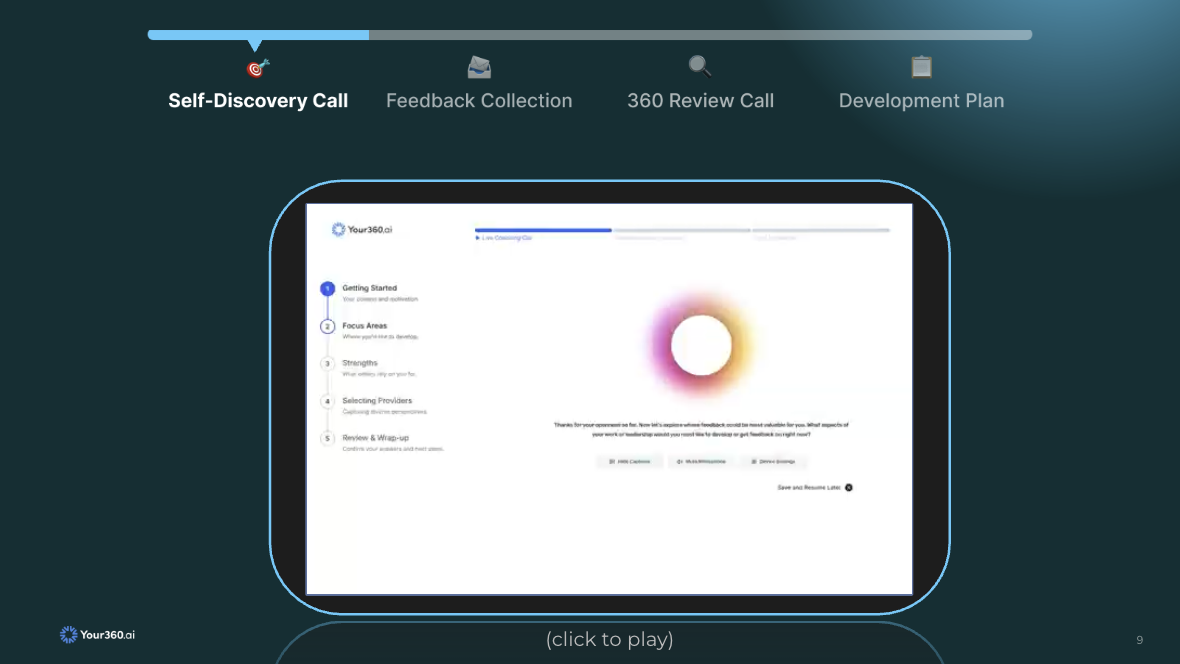
Before anyone else is asked for feedback, the employee sits down with Tam for a 15-minute voice conversation.
This isn't a self-assessment form. It's a coaching conversation.
Tam asks the employee about their goals, their strengths as they see them, the areas where they want to grow, and the context of their current role. She listens. She follows up. She helps the employee articulate things they might not have put into words before.
Here's how that sounds in practice. In a real product demo, an employee says to Tam:
"People see me as the person who fixes things, but I don't want to just put out fires. I want to be more strategic — designing systems so that fires don't start. I just don't know if my team sees that side of me."
Tam responds:
"So you want to move from fixing problems to preventing them, and you're wondering if others already recognize that. What would it look like if your team saw more of that from you?"
This conversation does two things. First, it gives the employee a chance to reflect before receiving feedback — which research shows significantly improves how people receive and integrate what they hear. Second, it gives Your360 AI's AI the context it needs to make the feedback that follows genuinely relevant. The employee can also plant seeds for specific areas they want feedback on — personalizing everything that happens next.
This self-discovery phase is where psychological safety begins. By starting with the employee's own perspective, the process honors their agency and creates a foundation of trust. They're not being evaluated. They're being supported.
Step 2: Feedback Collection — Voice Conversations With the People Who Know You Best
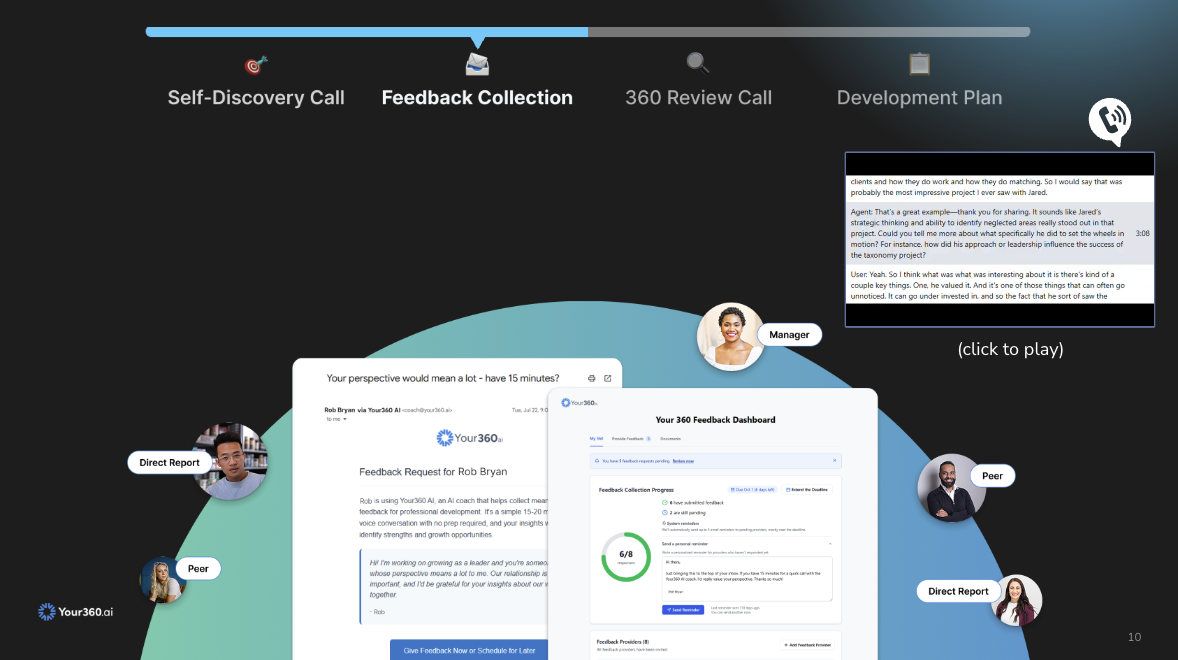
Once the self-discovery conversation is complete, the employee selects their feedback providers — typically 5–8 people including their manager, peers, and direct reports. The science-based default is three direct reports, three peers, and a manager (or four total for individual contributors without direct reports).
Each feedback provider receives an invitation to have a short voice conversation with Tam. Not a survey. Not a form. A conversation — one they can take on a walk, during a commute, or anywhere they feel comfortable speaking freely.
Tam asks each provider about the employee's strengths, their areas for growth, and specific examples of their impact. She adapts her questions based on the relationship — asking a direct report different things than she'd ask a peer or a manager.
And she follows up.
If a feedback provider says "Maya is great at execution," Tam doesn't move on. She asks: "Can you give me a specific example? What did that look like in practice?"
This is where the magic happens. A 10-15 minute voice conversation with Tam captures more depth, more specificity, and more honesty than a 45-minute written survey. Because people say things they'd never type.
For Maya's manager, this is the conversation where he'd finally say what he's been thinking: "Maya is incredibly responsive — sometimes too responsive. When a fire breaks out, she's the first to drop everything. I admire the dedication, but I worry it's getting in the way of her being seen as strategic. She's so good at fighting fires that people don't see her as someone who prevents them."
That feedback — specific, behavioral, honest — is exactly what Maya needs. And it's exactly what a survey would never surface.
The conversational AI format creates a unique dynamic. Feedback providers feel heard, not rushed. They can think out loud. They can revise their thoughts mid-sentence. They can share context that wouldn't fit in a text box. And because Tam is not a human colleague, not HR, not a consultant with an agenda, they feel safe being candid.
The platform is also highly customizable. Organizations can integrate their own frameworks — DISC personality assessments, company values, career ladders, competency models — so that feedback aligns with existing development language and structures. This customization ensures that the insights employees receive aren't generic but directly connected to the growth paths their organization values.
Step 3: Live AI Coaching Debrief — Where Feedback Becomes a Growth Plan
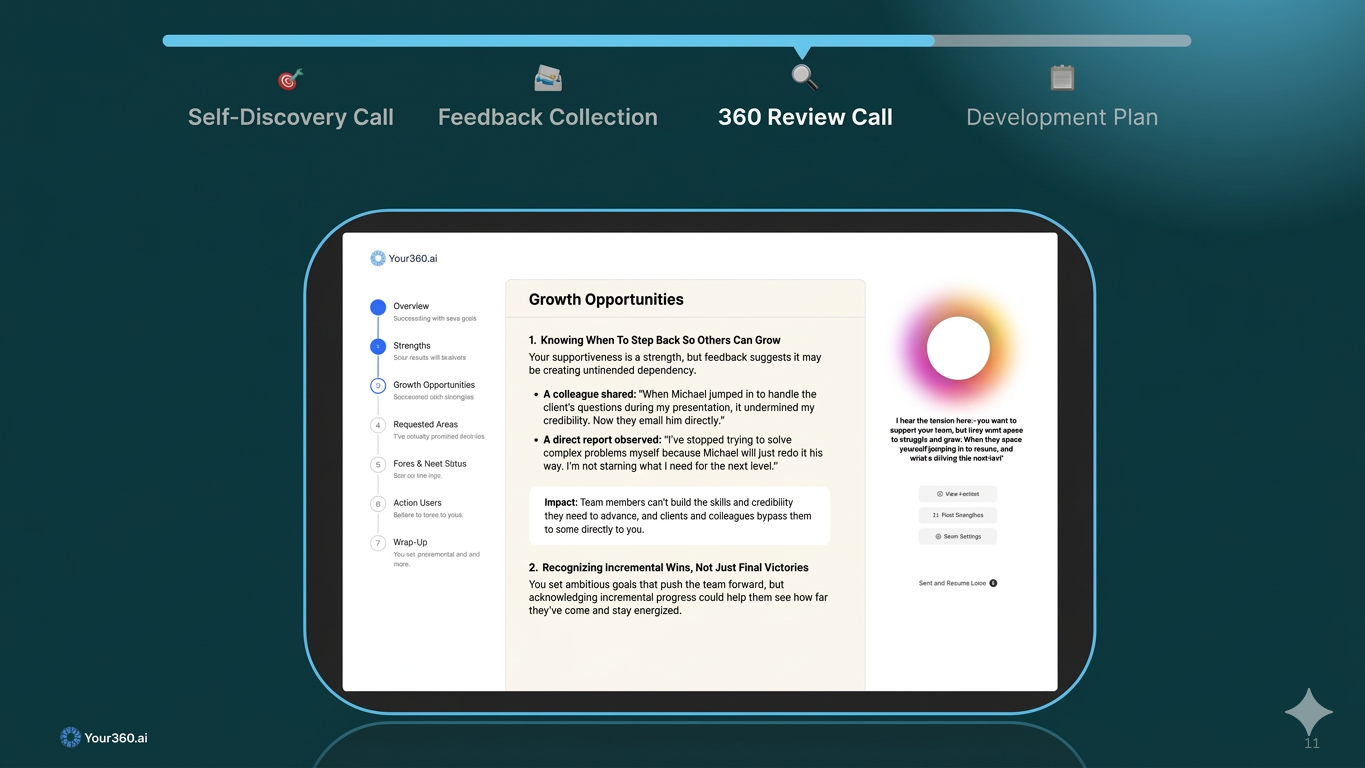
After all feedback conversations are complete, Your360 AI's AI synthesizes everything into clear themes, patterns, and insights. Then Maya sits down with Tam for her live coaching debrief.
This isn't a report. It's a conversation.
Tam walks Maya through what she heard — the strengths that came up consistently, the patterns that emerged, the specific examples that illustrate her impact. She helps Maya understand not just what people said, but why it matters and what to do about it.
For Maya, this is the moment she hears it: "The people around you see your responsiveness as a strength — and as something that might be limiting your growth. Several people mentioned that when a crisis hits, you're the first to respond. They admire it. But it's also shaping how they see your role. If you want to be seen as strategic, the question isn't whether to care about fires — it's about when and how you engage with them."
That's not a rating. That's a mirror.
And because it comes from a neutral AI coach — not her manager, not HR, not a consultant with an agenda — Maya can hear it without defensiveness. She can sit with it. She can ask follow-up questions. She can start to build a different story about herself.
As Jared Goralnick explains: "The difference between a coach walking someone through a 360 and someone just getting the document is the difference between about 30% satisfaction on the part of the recipient versus 95%. Having a coach or a trained facilitator is night and day in terms of whether these things work — and that is built into our entire product."
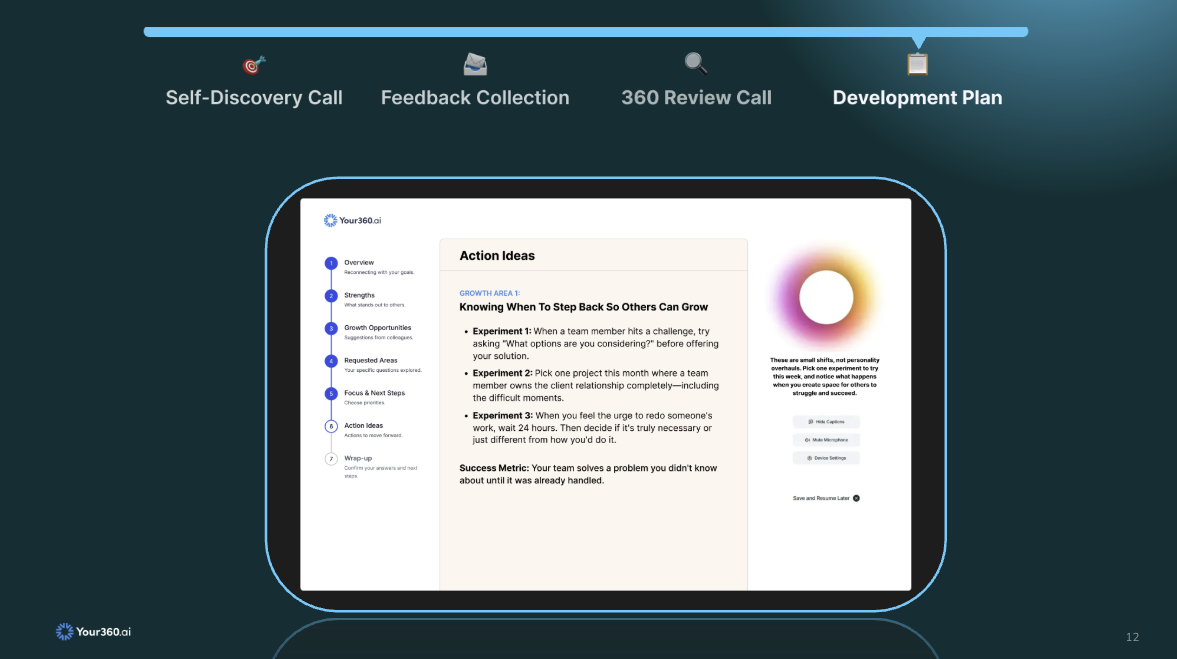
At the end of the debrief, Maya picks one or two focus areas and works with Tam to design specific experiments for the next 30 days. She gets a development plan artifact she can share with her manager — a springboard for a real conversation about growth.
This coaching debrief is where employee development truly begins. It's not about receiving feedback and filing it away. It's about processing it, making sense of it, and committing to concrete next steps. The AI coach doesn't just deliver information — she facilitates transformation.
Development, Not Evaluation: The Philosophy That Makes It Work
Here's what separates Your360 AI from every other 360 tool on the market: it is designed for development, not evaluation.
This distinction matters more than it might seem.
When feedback is tied to performance ratings, compensation, or promotion decisions, people stop being honest. Feedback providers soften their input. Employees become defensive. The whole system collapses into performance theater rather than a genuine conversation about growth.
Your360 AI is built on the opposite principle. Feedback is confidential. The employee owns their results. The goal is growth, not judgment.
This is why Amy Edmondson's research on psychological safety is so central to what we do. When people feel safe — when they know that honest feedback won't be weaponized — they give it. And when employees receive feedback in a space that feels safe, they can actually use it.
One customer described it this way: "She cried, screamed, got a little angry — working through some hard feedback with the coach. And she said: 'It was really great because I did that with the coach, because I certainly couldn't do that with my boss.'"
The voice-first format is the mechanism. The development-first philosophy is the reason it works.
This philosophy also shapes how results are shared. Employees decide what, if anything, to share with their manager. The default is that managers see only what the employee chooses to disclose. This autonomy reinforces trust and ensures that the 360 remains a tool for self-improvement, not a surveillance mechanism.
For organizations worried about accountability, this might seem counterintuitive. But the research is clear: when employees feel ownership over their development, they're more likely to act on it. Forced transparency breeds compliance. Voluntary transparency breeds commitment.
What Users Are Saying
The proof is in the conversations.
"This is honestly the most helpful, actionable career advice I've ever received. Thank you!" — Senior Product Manager, Dropbox
Our co-founder Renata Bell went through the process herself at a team offsite. She wrote about what happened:
"The feedback wasn't new. The way I was able to receive it was. Instead of defensiveness or analysis, there was space. Space to listen. Space to feel. Space to consider a different, kinder story about myself. Without a human in the loop, which made it safer to process."
That's the experience we're building toward — for every employee, not just executives.
What these testimonials reveal is that voice-based 360 feedback doesn't just feel better — it works better. The combination of psychological safety, conversational depth, and personalized coaching creates conditions for real transformation, not just polite acknowledgment.
Pricing: Accessible at Every Scale
Your360 AI is designed to be accessible at every level of the organization:
Individual: $350 — Full 360 on your own terms: self-discovery, feedback collection, AI-coached debrief, and personalized growth plan. Perfect for employees who want to take ownership of their development or test the platform before rolling it out to their team.
Team: $2,500 for up to 8 people ($249/additional person) — Full 360 experience with admin dashboard, customizable questions, and team insights report. Ideal for managers who want to invest in their team's development or L&D leaders piloting the platform with a single cohort like a new manager cohort, a leadership offsite, or a cross-functional project team.
Enterprise: Custom pricing — For organizations rolling out 360s across teams, departments, or company-wide. Includes HRIS integration, SSO/SAML, dedicated people scientist support, and white-glove onboarding. Designed for L&D and OD leaders who want to embed voice-based feedback into their talent strategy.
Traditional consultant-led 360s cost $10,000+ per person and take 2–3 months. Your360 AI delivers the same depth at a fraction of the cost, in 2–3 weeks.
This pricing structure makes executive-quality feedback accessible to employees at every level. A first-time manager can get the same caliber of insight as a VP — without the organization needing to hire an external coach or consultant.
The Bottom Line for L&D Leaders
If you're a Learning & Development leader, you've probably seen this pattern: you invest in a 360 program, employees complete the surveys, reports get generated — and then nothing changes. People read their results, feel vaguely defensive or vaguely validated, and go back to work exactly as before.
The problem isn't the concept. The problem is the format.
Voice AI changes the format. And when the format changes, the feedback changes. And when the feedback changes, people actually grow.
Your360 AI is not a better survey tool. It's a fundamentally different approach to how feedback is collected, synthesized, and delivered — one that's grounded in the research on psychological safety, honest communication, and what actually drives employee development.
We built it because we believe that coach-quality feedback shouldn't be a privilege reserved for the top 1% of your organization. Every employee deserves to see themselves clearly — and to have the support to grow from what they see.
For L&D leaders, this means you can finally offer development experiences that match your ambition. You can roll out 360s that people actually want to participate in. You can generate insights that inform not just individual growth plans but organizational strategy. And you can do it without hiring an army of coaches or consultants.
The future of employee development isn't more surveys. It's better conversations. And voice AI makes those conversations possible at scale.
Want to go deeper? Read more from the Your360 AI blog:
- Why L&D Leaders Are Embracing Voice-Based Feedback — and Saying Goodbye to Traditional Surveys
- Escaping the Feedback Trap: How OD Leaders Can Ditch Performance Theater for Real Growth
- The Performance Theater of the Text Box: Why Voice AI is the Truth Serum Your Culture Needs
- See how it works →
Ready to See the Difference?
Give your people feedback that actually works. We'd love to show you what Your360 AI looks like in practice — no forms, no ratings, just real conversations that drive real growth.
Book a Free Demo →